 |
Artist Information Order of the Garter Order of the Bath Garter Crests Bath Crests
Family/Arms Crests Heraldry Home Page Crest/Arms Short TV Films FAQs
|
The carved and painted Crests of the Knights of the Most Honourable Order of the Bath
The Order of the Bath consists of the Sovereign (The Queen), the Great Master (The Prince of Wales) and three classes of members. The title of the Order is late medieval in origin and arose from the ritual washing (inspired by the washing of baptism), a symbol of spiritual purification, which formed part of a knight's preparations for the conferment of knighthood.
During the 13th and 14th century Crests were often worn on top of the Knights helm (Battle Helmet) and the Knights Coat of Arms painted upon his shield. During Battle, Pageants or at Tournaments and are used as a form of identification and often during such contests, if a Knight was knocked off his horse his Crest often become dislodged thus rendering the Knight.. Crest fallen…..

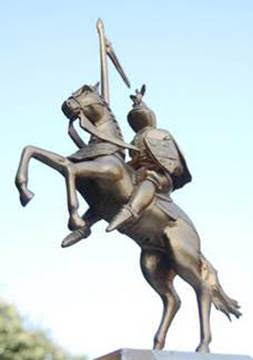

Ian's GB's sculpture depicts a Knight in full Battle armour wearing his 'Phoenix Crest placed upon his Helmet with the outline of his Arms etched upon his shield.
A 20th century Knight of the Bath Crest then placed in position upon his helm in Henry V11’s Lady Chapel in Westminster Abbey alongside other totally unique Bath Knights Crests.
Beneath the carved and painted crests, the knight's mantling hangs either side of the helm which is symbolic of the cloth that would have helped protect the knight in his armour from the rain or sun. The knights banner which was often carried in battle bearing his coat of arms, these arms were also often worn as a tabard over his armour.
Due to the limited number of stalls (seats) available in Henry VII Chapel only the most senior Knights Grand Cross can be installed.
Shown below are the Knights of the Bath Crests that Ian GB created which were then placed in Henry VII Chapel, the Lady Chapel in Westminster Abbey since 1989 for the most senior Knights Grand Cross of the Most Honourable Order of the Bath. Ian G Brennan was officially appointed the Sculptor to the Most Noble Order of the Garter and the most honourable Order of the Bath in 1989 and since then has also been commissioned to create in three-dimensions all the Crowns, Coronets and Crests for all the Royal Knights, Extra Knights, Knights and Lady Companions of the Most Noble Order of the Garter along with several Knights swords. These Knights Crests are around 10 - 20 inches high and take Ian between three and six weeks to create depending on how complex they are. They are then placed in position above the Knights Helm, in Henry V11 Chapel in Westminster Abbey.
Ian has produced all the Crowns, Coronets, Badges and Crests for the Knights of the Garter and Knights of the Bath since 1989 and continues to do so today.
 |
|
Shown in Ian G Brennan’s studio during 2005, are four carved and painted Knights of the Bath crests, a carved coronet for a Lady of the Garter along with two Knights of the Garter carved Stag Crest for former British Prime Minister Sir John Major. |
Due to the limited number of stalls (seats) available in Henry VII Lady Chapel only the most senior Knights Grand Cross can be installed. Nine new Knights Grand Cross of the Most Honourable Order of the Bath (GCB) were installed at Westminster Abbey by HRH The Prince of Wales on Tuesday 25 May 2010 and took place in the Abbey's Lady Chapel - which is also the Chapel of the Order of the Bath, of which the Prince of Wales is the Great Master.
Shown below are all of the Knights of the Bath Crests that have been placed in Henry VII Chapel, the Lady Chapel in Westminster Abbey from between 1989 and 2026 for the Knights Grand Cross of the Most Honourable Order of the Bath.
 |
 |
please click to enlarge


Sir John Gibbon |
General Sir Patrick Howard-Dobson |
Field Marshal Sir Roland Gibbs |

Sir David Williams |

Lord Beetham |

General Sir Harry Tuzo |
|
Sir Horace Law (Admiral) |

General Sir Cecil Blacker |

Lord Charteris of Armisfield |

Sir Charles Cunningham G.C.B. |
Lord Croham |
Air Chief Marshal Sir Neil Wheeler |

Sir Frank Cooper |
Admiral Sir Anthony Griffin |
Air Chief Marshal Sir Denis Spotswood |
Admiral of the Fleet Sir Edward Ashmore |
General Sir Richard Worsley |
Sir Henry Leach, Admiral-of-the Fleet |
|
General Sir Peter Whiteley |

Sir Douglass Wass |
Sir David Fraser |
|
Sir Douglas Lowe |
Lord Armstrong of Ilminster |
The Rt Hon Sir Patrick Nairne GCB MC |
Sir Robert Ford |
Sir Brian Cubbon |

Sir William Kerr Fraser |

Sir David Evans |
Sir James Eberle |

Lord Craig of Radley |

Sir Roland Guy |
Sir George Cooper |
Air Chief Marshal Sir Jock Kennedy |

General Sir Michael Gow |

Admiral Sir Desmond Cassidi |

Air Chief Marshal Sir Peter Terry |

Sir John Stanier |
Marshal of the Royal Air Force Sir Peter Harding |
Sir Nicholas Hunt |

Field Marshal Sir John Chapple |

Lord Moore of Wolvercote |

Sir Brian Kenny |

Sir Peter Middleton |

Sir David Parry-Evans |

Sir Patrick Hine |

Sir Benjamin Bathurst |

Sir Kenneth Stowe |

Sir Julian Oswald |

Sir John Wilsey |

Field Marshal Lord Inge |

Admiral Sir Jock Slater |

Lord Ramsbotham |

Lord Butler |

Sir John Waters |

Lord Guthrie of Craigiebank |

Sir Michael Graydon |

Sir Michael Alcock |

Sir Roger Wheeler |

Sir Dereck Oulton |

Sir Anthony Battishill |

Lord Burns |

Sir Richard Johns |

Admiral Lord Boyce |

Sir Jeremy Mackenzie |

Lord Walker |

Sir Nigel Wicks |

Sir Ian Dinton |

Air Chief Marshal Sir Peter Squire |

Lord West of Spithead |

Lord Stirrup |

Sir Haden Phillips |

Admiral Sir Nigel Richard Essenhigh |

General Lord Dannatt |

Air Chief Marshal Sir Glen Torpy |

Admiral Sir Jonathon Band |

Admiral Sir Mark Stanhope |

Sir David Omand |

General Sir Michael David Jackson |

Lord Richards of Herstmonceux |

Lord Hougton of Richmond |

Sir Nick Carter |

Sir Peter Wall |

Sir Andrew Pulford |
Sir David Normington |
Although each Knight of the Bath and Knight of the Garter Crest when displayed in Henry V11 Chapel in Westminster Abbey and St George’s Chapel in Windsor Castle are only viewed from the front and sides therefore over the centuries Ian like his predecessors were not required to carve the back of the Crests, as shown below on this centuries old carved Royal Crest.
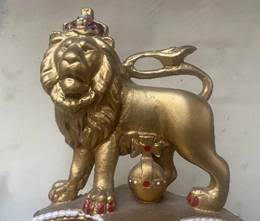
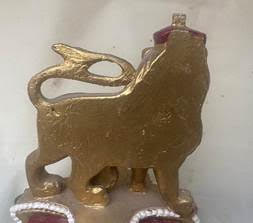
However, for the past thirty plus years Ian has carved, painted and gilded the Crests from all sides as can be seen from the most recent example the ‘sea horses’ Crest below.


 |
 |
|
 |
|
Artist Information Order of the Garter Order of the Bath Garter Crests Bath Crests
Family/Arms Crests Heraldry Home Page Crest/Arms Short TV Films FAQs

Under Construction


